There’s a saying in tech that you should eat your own dog food. At Goody, we prefer “drink your own champagne”, but either way, gifting is a huge part of our own demand gen strategy.
This year, Goody’s sales and marketing teams used gifts to win over cold and cooled-off prospects and customers in two different campaigns.
As gifting-pilled as we are, we were still astonished by the ROI. For about $23K in gifts, we generated over $700K in pipeline, with $207K of it already closed (as of mid-November, 2026). That’s a 9X ROI that continues to climb.
In a world of declining ROAS (Return on Ad Spend) on most marketing channels, 900% ROI from gifts can feel unbelievable. These case studies below demonstrate the real power of gifts for demand gen, and help debunk some of the persistent myths about incentivizing sales meetings.
How We Built It:
These two campaigns below put a similar offer in front of different audiences on two different channels:
- Colder prospects on LinkedIn
- Dormant customers and prospects in our CRM
In both channels, we used gifts to warm things up and incentivize a short conversation with sales. For a brief meeting, we offered $200 physical gifts (like a YETI cooler or a Ninja Creami).
Here are the Goody features we used:
- Collections: Offer a limited menu of $200+ gifts that our customers could choose from, reducing decision fatigue
- Calendly integration: Offer a gift only after a meeting was booked with our sales team
- Smart Links: A single reusable gift link that we could deploy in our ad creative and emails
- Approvals: Goody employees will approve and send a gift only after a meeting had occurred
- Goody MCP: To send notifications and alerts to our internal Slack channel
Campaign One: How Gifts Cut Our LinkedIn Cost-Per-Meeting By 87%
With social ads, conventional wisdom says cold prospects won’t book a demo until they’re familiar with your brand.
So that’s how we initially approached ABM on LinkedIn. We built a list of about 1,500 companies, and spent July putting our thought leadership in front of them with no ask at all. Only when users had engaged with our awareness ads did we make our direct CTA: a $200 YETI cooler for anyone who booked a demo.
Over those two months we booked four meetings, and each one cost $2,957, virtually all of it in media spend. The gift itself was only $200 of those costs, with the rest going to LinkedIn.
So we tried something different. We scrapped the warm-up and led with the gift, showing an ad that promised the same YETI cooler in exchange for a demo. We advertised to a brand-new list of companies that had never seen our content or heard of Goody.
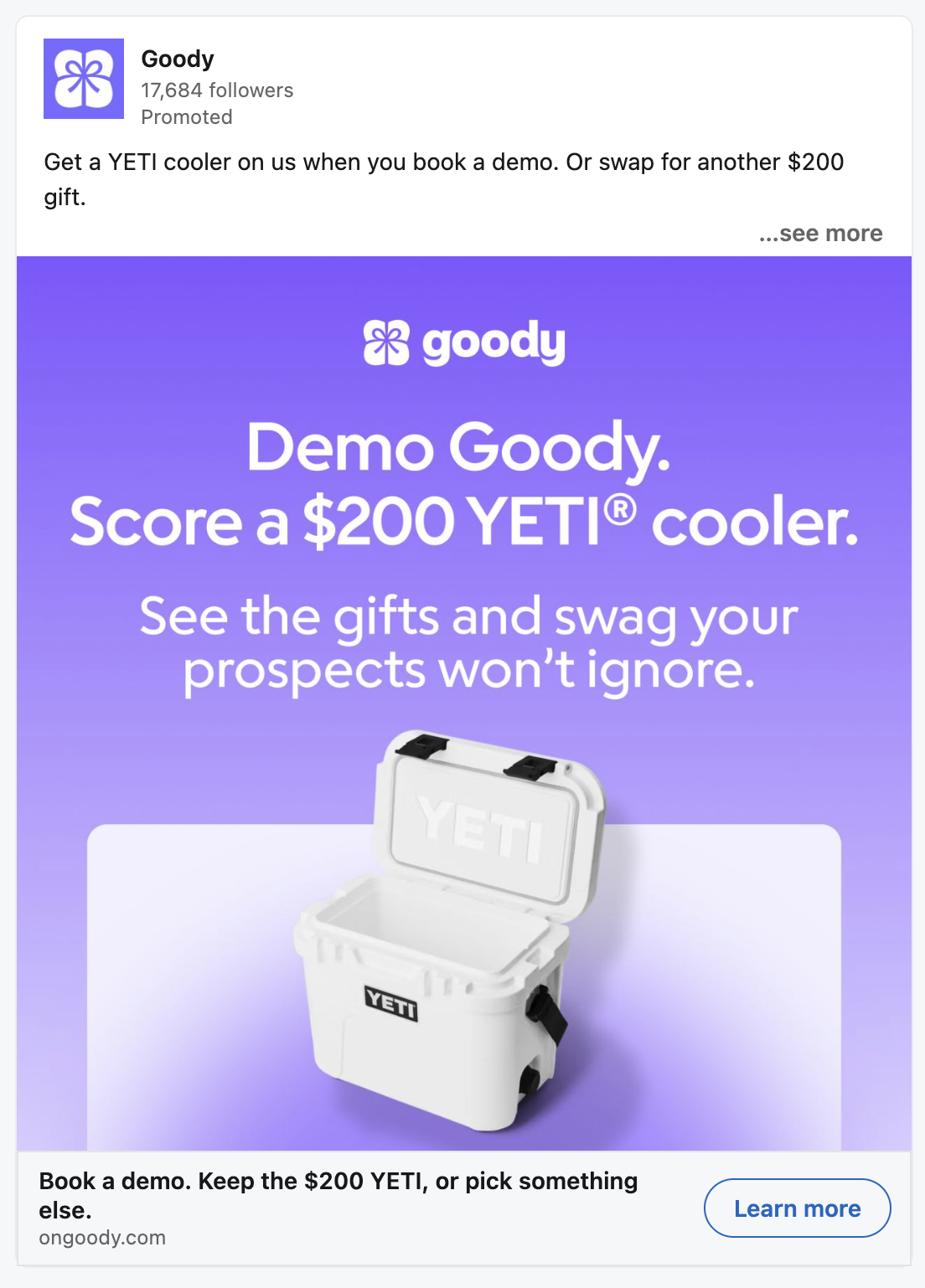
In four weeks, we booked more than 50 meetings. We’ve seen more than $200K in pipeline, and have two Enterprise software customers in contract.
With the gift-first approach, each meeting cost about $400 in total spend, which is 87% less than the warm-up approach. Every meeting still came with a $200 gift, so the savings came from the LinkedIn ads spend, which plummeted from roughly $2,750 per meeting to about $200.
The takeaway for any marketer is that instead of giving LinkedIn $2,500 per meeting to warm up your audience, you can spend $200 on a gift through Goody, and have your sales reps warm up the audience for free on a call.
On each demo, our sales team walked prospects through the gift catalog and marketing use cases. Things got meta. We showed them how to connect their CRM and send gifts based on their own triggers and workflows, which meant the offer that got them on the call was also a preview of the product.
The lesson: Gifts are the ultimate LinkedIn advertising hack. They allow you to book demos at rates that would be unimaginable via traditional methods of warming up and converting your audience via ad creative.
Campaign Two: Unlocking $500K Pipeline From Dormant CRM Contacts
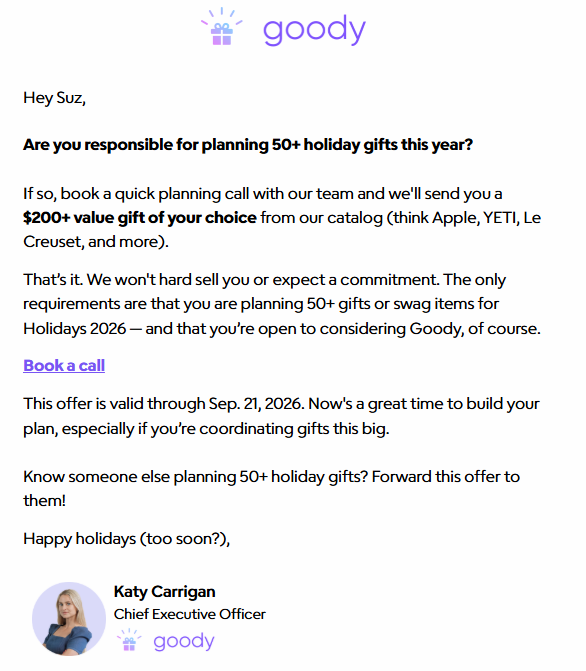
Our database is full of people who already know Goody, including past prospects, former customers, and plenty of contacts who have drifted away. We already send regular marketing emails to these contacts, so we hypothesized that the standard “the holidays are coming” email wasn’t likely to bring many of them back.
This time, they heard from our CEO, Katy Carrigan, asking whether they were planning 50 or more holiday gifts this year. The email invited them to take a 25-minute planning call with us in return for a $200 gift of their choice, naming popular brands like Apple, YETI, and Le Creuset. We kept the pressure low and made it easy to forward the offer to a colleague.
The emails booked 48 meetings and drove over $550K in holiday pipeline, with more than $200K closed-won. That’s against less than $10,000 spent on gifts.
The lesson: Gifts can unleash the latent value that’s hiding in your CRM. Thousands of customers and prospects might be ignoring your sales and marketing emails, but the right gift offer will break through.
Incentivized Meeting Campaigns: Safeguards You Need
Anytime you’re offering a $200 gift, you’ll want some basic safeguards in place to protect your gift budget.
- Add clear conditions in the ad creative and routing: We make it clear to customers that they’ll need to hit certain thresholds to book the meeting and get the gift.
- Use approvals and require work emails: You can configure your Smart Links to require work emails. You should also ensure approvals are turned on, so you only release the gifts after the meeting has occurred.
- Target thoughtfully: Make sure your LinkedIn ads and emails are reaching the right audiences that you really want to meet with.
Myth 1: Incentivized Meetings Attract Bad-Faith Attendees
The biggest worry we hear about gift-incentivized meetings is that they attract opportunists who only want the gift.
Boy, oh boy, how we wish we could put this myth to rest! Yes, you’ll get the odd person who is just pursuing a freebie. That’s the exception, not the rule. Provided your CRM or ad targeting is thoughtful, and you’re not offering low-value prospects high-value gifts, there are surprisingly few prospects who will waste your time.
The vast majority of senior professionals (the type of person you’ll likely target), value their time highly enough that they won’t take an irrelevant meeting just to score a gift.
Reality: We find fewer than 5% of people taking meetings are bad-faith attendees who only want a gift. Compare that with the percent of ad spend that goes to irrelevant audiences.
Myth 2: Incentivized Meetings Don’t Convert
Similar to the notion that you’ll attract irrelevant people, there’s a myth that these types of meetings don’t convert into real sales.
We found that our conversion rate was lower than inbound leads from our website, but well worth the amount we paid for them. We’ve already seen more than $200K real sales closed from these campaigns.
Reality: Incentivized meetings require more long-term nurture than demo leads from your website, yet the close rate is higher than thought leadership leads like webinar attendees or whitepaper downloads.
Myth 3: Basic Gift Cards Work Best
Interestingly, we found major advantages in choosing specific physical products in our marketing. It allowed us to create more visual LinkedIn ads than we could with, say, an Amazon gift card. We also heard from customers and prospects who booked meetings that physical gifts felt more tangible and exciting than a purely functional Amazon card.
Reality: Gift cards can work well. Yet the gold standard is physical gifts that feel personalized to your audience. For example, if you’re trying to reach construction-industry leaders, then high-quality work boots would perform better than a DoorDash gift card.
What It Added Up To
Together, about $23K in gifts has opened over $700K in pipeline, and $207K of it has already closed. This is 9x ROI on the gifts alone, with more deals still in play.
A gift gives a busy person a reason to say yes before they know much about you, as one marketer on one of these calls put it:
“I’m looking for solutions where I could do campaigns like the one I saw, where I can offer you a gift to come to a meeting.”
Want to see how gifting could work for your own prospecting? Book a call with our team and we’ll show you how to build your own demand gen campaigns like these.