TL;DR
- Gift cards are always taxable to employees. The IRS treats them as cash equivalents, so they go on the W-2 at any dollar amount.
- They work well for quick, low-budget recognition ($5 to $25), like a coffee run or a thank-you for covering a shift.
- At higher budgets, a Gift of Choice on Goody gives recipients the same flexibility (they pick what they want from 600+ brands) without the price showing, and the gift may qualify for better tax treatment.
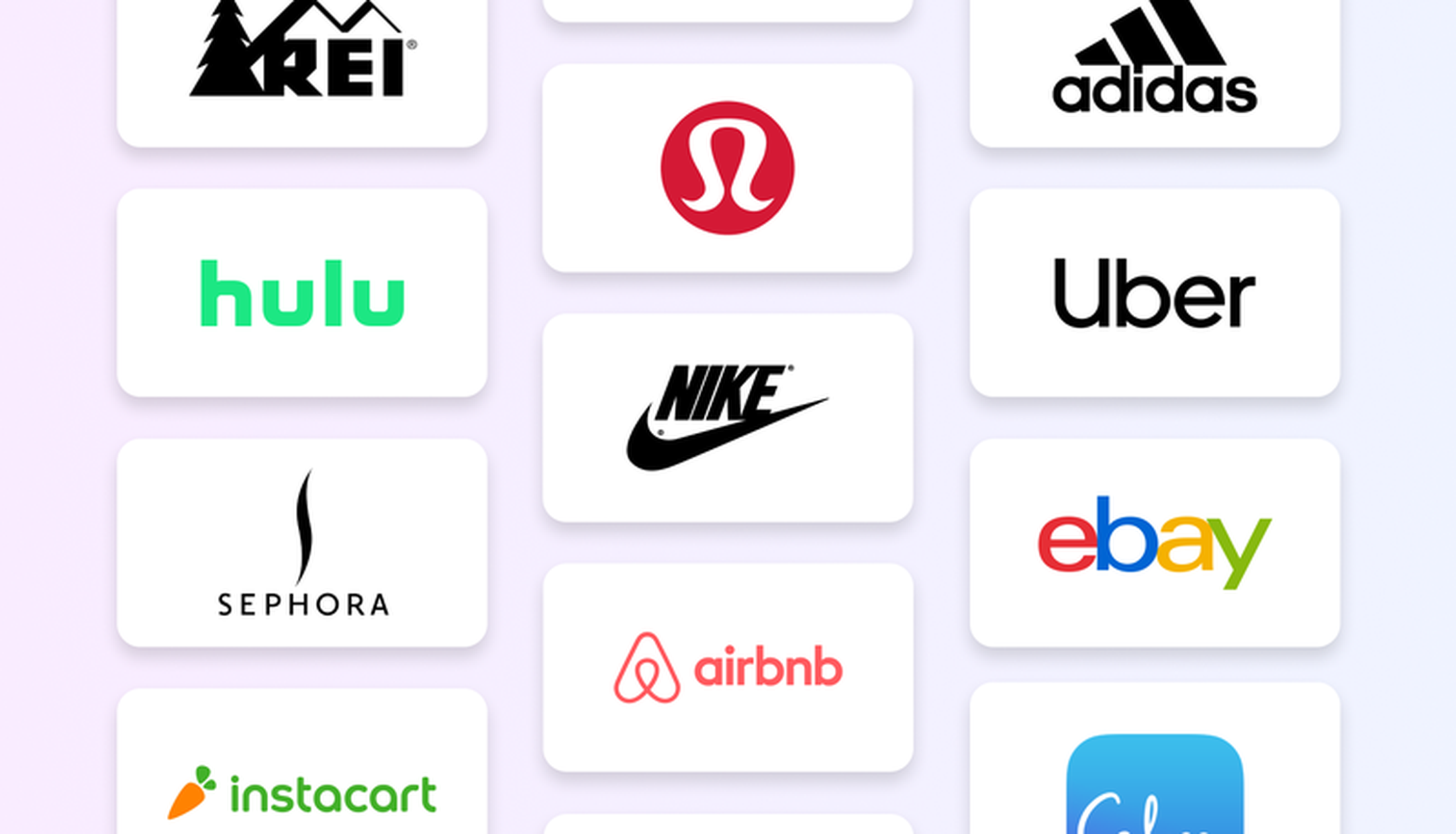
- Goody also carries e-gift cards ($5 to $2,000) from brands like DoorDash, Uber Eats, Sephora, and Ulta, delivered instantly by email.
Gift cards are one of the most popular employee gifts in the U.S., and for good reason. They're fast, flexible, and the recipient gets to pick something they want. But they come with a tax wrinkle most companies overlook. And at higher budgets, they can feel more like a transaction than a thank-you.
This guide covers when gift cards make sense, how the IRS treats them, and what to consider when you want the same flexibility with more of a personal touch.
How the IRS treats employee gift cards
The IRS is clear on this: gift cards and gift certificates are cash equivalents, and cash equivalents are always taxable compensation, regardless of the dollar amount. A $10 Starbucks card gets the same tax treatment as a $500 Visa gift card. Both must be reported as wages on the employee's W-2.
This catches a lot of companies off guard. Physical gifts of small value, like a food gift basket, a branded water bottle, or a bouquet of flowers, can qualify as what the IRS calls a "de minimis fringe benefit" under Section 132(e). In plain terms, "de minimis" means a benefit so small and infrequent that it would be unreasonable for the IRS to require you to track it. Think: a holiday turkey, a company T-shirt, occasional snacks in the break room. Those are excludable from the employee's income. Higher-value items like AirPods or a nice backpack are less clear-cut and may need to be reported, depending on the specifics.
Gift cards don't qualify, at any amount, because the IRS considers them the same as handing someone cash. As The Tax Adviser (AICPA) explains, "gift cards are almost always excluded from the de minimis rules, no matter how low the dollar amount, because they are cash equivalents."
Two things to note here: there's no $25 exemption for employee gift cards (the $25 limit under IRS Section 274 applies to client gifts, not employees), and your payroll team needs to add gift card values to W-2 wages. If managers send gift cards through their corporate card without telling payroll, you have a compliance gap.
For a deeper breakdown of employee gift tax rules, see Goody's employee gift tax guide.
Where gift cards fall short
The higher the budget and the more significant the occasion, the more a gift card starts to feel like compensation rather than recognition.
They don't unwrap
Part of what makes a gift feel like a gift is the experience of receiving it: the anticipation, the surprise, the physical object that arrives. A gift card code in an email doesn't create that moment. For milestones like a work anniversary, a holiday, or an employee's birthday, this matters.
They carry the wrong tax signal
Because the IRS treats gift cards as taxable wages, they show up on your employee's pay stub alongside their salary and bonus. That blurs the line between a gift and additional compensation. A physical gift of nominal value, on the other hand, may not need to be reported at all.
They're hard to make personal at scale
Writing a heartfelt message on a $25 Amazon card for each of your 200 employees isn't realistic. The format itself makes personalization tricky. When a company sends hundreds of identical gift cards, the intended message ("we appreciate you") can read as "we needed this done quickly."
Gift of Choice and other alternatives that keep the flexibility
One more thing worth mentioning: with all three approaches below, you're charged only when the recipient accepts. If someone doesn't claim their gift, you're never billed. That changes the math compared to buying 200 gift cards upfront, where every dollar is spent whether or not the recipient uses it (and billions of dollars in gift cards go unspent each year).
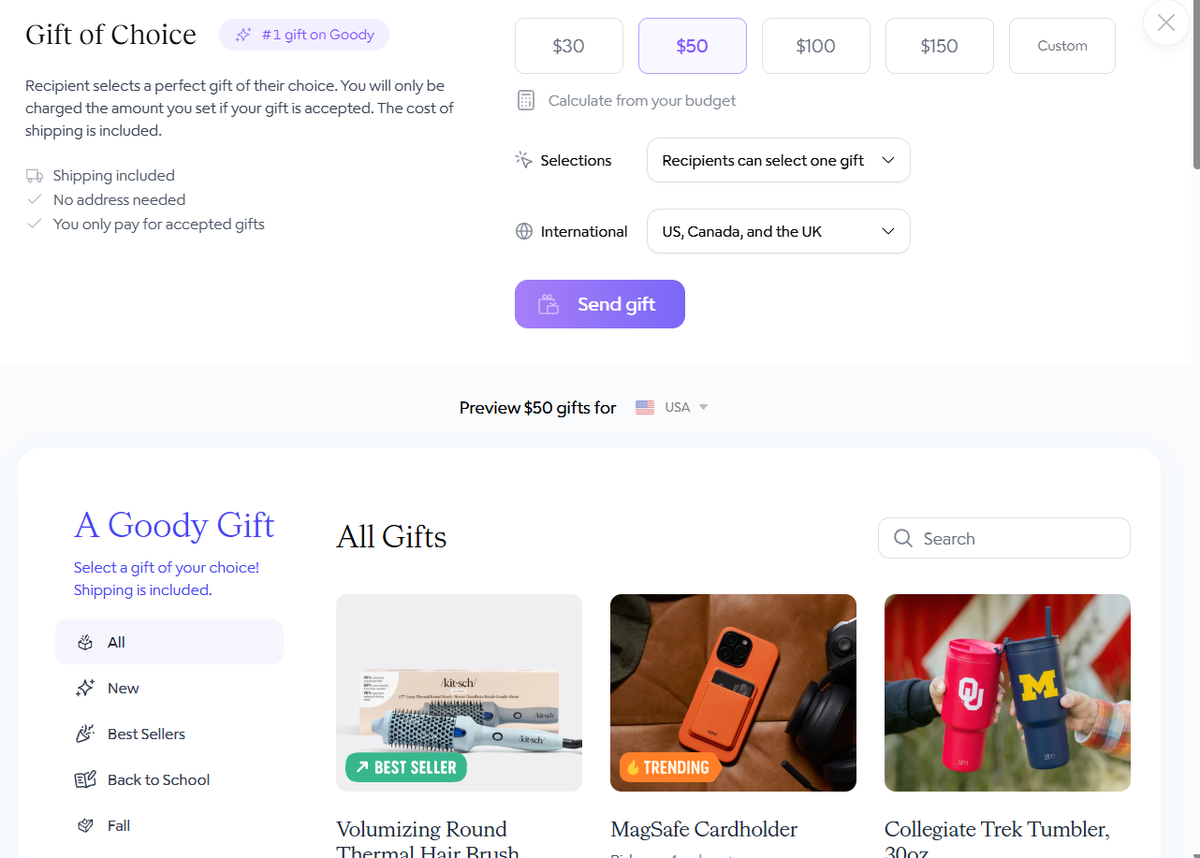
Gift cards optimize for one thing: letting the recipient choose. But that's not unique to gift cards. A Gift of Choice on Goody does the same thing, with a few key differences: the recipient picks a physical gift from 600+ brands instead of a store balance, and the price is hidden so it doesn't feel transactional. Because the gift is a physical product, it may also qualify for more favorable tax treatment (consult your tax advisor for your specific situation). For a deeper look at why this distinction matters at tax time, see the full employee gift tax guide.

The personalization difference matters too. With a Gift of Choice, each recipient browses Goody's catalog and picks something different. One person grabs a Le Creuset piece, another picks a Therabody massager, someone else chooses Quince cashmere. The gift arrives with a branded digital card and their name on it. That's a different experience than 200 people receiving the same Amazon gift card.
Here's how the three main alternatives work.
Let them choose from the full catalog
With a Gift of Choice, you set a budget (starting at $15), and the recipient browses 600+ brands, from Fellow coffee gear to Brightland olive oil sets. The price is not shown to the recipient by default, so it feels like opening a gift versus redeeming a voucher. The sender experience is just as fast as buying a gift card: pick a budget, add a personal note and digital card, send by email. No address needed. Recipients enter their own shipping details when they accept.

Curate a smaller menu
With a Custom Collection, you pick a handful of gifts and the recipient chooses from your selection. This is a strong option when you want to guide the choice without guessing preferences. Build a collection across a few categories (a premium candle, a nice notebook, a food gift, a piece of drinkware) and each person picks the one that fits them. Collections are available on all Goody plans and can include branded swag if you want to mix company-branded items with retail gifts.
Send a specific gift with a swap option
If you have a particular item in mind, you can send that specific gift and let the recipient swap it for something else of equal value if it's not their style. This gives you creative control while building in a safety net for personal preferences.
When gift cards are the right choice
Gift cards aren't inherently a bad gift. For certain situations, they're the most practical option.
Quick, lightweight recognition
A $10 to $25 gift card to a coffee shop or food delivery service works well for in-the-moment appreciation: someone stayed late to finish a project or covered a coworker's shift. The gesture is immediate, and the dollar amount is low enough that the tax impact is minimal (even though it's still technically reportable).
International employees
This is where gift cards can shine. Shipping a physical gift internationally means customs, duties, and longer delivery windows. An e-gift card in the recipient's local currency sidesteps all of that. On Goody's paid plans (Pro and Team), you can send international gift cards to team members in 140+ countries, denominated in their local currency, delivered instantly by email. A team member in London gets a card they can use at local retailers, not a U.S.-only card with foreign transaction fees. For companies with distributed teams, this is one of the fastest ways to recognize someone abroad without any shipping logistics.
Tight budgets (under $15 per person)
At very low per-person budgets, a gift card lets each person choose something useful rather than receiving a generic item that may not fit their taste. When the budget is $5 to $15, the options for a physical gift that feels considered are limited.
If you're sending gift cards through Goody
Goody offers e-gift cards from brands like DoorDash, Uber Eats, Sephora, Ulta, and dozens more, ranging from $5 to $2,000 per card. You can send them with just an email address, and the recipient gets a digital notification instantly.
A few advantages over buying gift cards directly from the vendor's site:
- Everything in one place. Instead of managing accounts across a dozen retailers, you can send gift cards from multiple brands through a single dashboard, with the same bulk sending tools you'd use for physical gifts.
- International gift cards are available on paid plans (Pro and Team), denominated in the recipient's local currency and delivered instantly. You skip customs paperwork, shipping delays, and address collection entirely. For global teams, this is often the simplest way to send recognition across borders.
- You can mix formats. In a Custom Collection, you can include both physical gifts and gift cards, so the recipient can pick whichever format they prefer.
- Same bulk sending tools. Upload a CSV of email addresses, add a personal note with first-name tokens for personalization at scale, and send to your entire team at once. Learn more about bulk gifting on Goody.
Gift cards are a legitimate gift, and sometimes the right one. The key is knowing what you're optimizing for and what the tradeoffs are.
Budget guidance by occasion
How much to spend depends more on the occasion and your team size than on the format.
Spot recognition and small wins ($5 to $25). A gift card is often the simplest option here. Coffee, food delivery, or a retail card in this range works well for a quick thank-you. The tax impact is real but small.
Birthdays and work anniversaries ($25 to $75). This is where a physical gift or a Gift of Choice starts to pull ahead. At $50, a gift card feels transactional. A candle from Boy Smells or a Brightland olive oil set at the same price point arrives as something the recipient wouldn't buy themselves. That's the difference.

Holidays and company-wide gifts ($40 to $100+). The occasion matters more here, and a gift card at this price point can read as impersonal, especially if every department gets the same card. A Gift of Choice or Custom Collection at $50 to $100 lets each person on your team pick from 600+ brands, and the gift shows up with a branded digital card and their name on it.
Executive and leadership gifts ($100 to $500+). Gift cards start to lose their appeal at this level. A $500 Visa gift card is generous, but the recipient still has to report it as income, and the format doesn't match the occasion. A curated gift, whether it's a Le Creuset piece, a premium experience, or a Gift of Choice at a higher budget, lands as something worth keeping.
How to send gift cards (or alternatives) to your team
Whether you're sending gift cards or physical gifts, the logistics work the same way on Goody:
- Pick the gift format. Gift of Choice, Custom Collection, a specific item, or a gift card.
- Add your recipients. Upload a CSV with names and email addresses. No shipping addresses needed. Recipients enter their own when they accept.
- Write a personal note. Add a digital card and message. Use first-name tokens to personalize at scale, or clone the send to write individual notes.
- Send. Recipients get a digital notification via email or SMS. The whole process takes a few minutes, and same-day sending works for any occasion.
You're charged only when a gift is accepted.
Whether you're sending gift cards, a Gift of Choice, or a mix of both, Goody gives your team the flexibility to pick what they want while keeping the experience personal. Sign up free on Goody to send your first gift, or book a call to plan a gifting program for your team.
Common questions
Are gift cards taxable to employees?
Yes, always. The IRS classifies gift cards as cash equivalents, which means they're taxable compensation at any dollar amount. They must be reported as wages on the employee's W-2. Physical gifts of small value may qualify as tax-free fringe benefits, but gift cards are specifically excluded. The IRS guidance spells this out: "Cash or cash equivalent items provided by the employer are never excludable from income."
What's the $25 limit I keep hearing about?
That's the Section 274 deduction limit, and it applies to gifts given to clients, vendors, and other non-employees. It caps how much of a business gift the company can deduct, at $25 per recipient per year. It has nothing to do with employee gift taxation, which is governed by separate fringe benefit and reportable income rules.
Can I gross up gift cards to cover the tax hit?
Yes. If you want a $50 gift card to truly feel like $50, you can add extra to cover the estimated income and payroll taxes. The exact amount depends on the employee's tax bracket, but a rough rule of thumb is to add 30 to 40% on top of the card value. Your payroll team can calculate the precise gross-up for each employee.
Is there a way to give employees choice without the gift card tax issue?
A physical gift that the recipient chooses for themselves can offer both flexibility and potentially more favorable tax treatment. On Goody, a Gift of Choice lets recipients browse the full catalog and pick their gift without seeing the price. Because it's a physical product, it may qualify for more favorable tax treatment depending on value and frequency. Consult your tax advisor for your specific situation.
How do I handle gift cards for remote and international employees?
For domestic employees, e-gift cards sent by email work regardless of location. For international team members, Goody's paid plans include gift cards in 140+ countries, denominated in the recipient's local currency and delivered instantly by email. No customs paperwork, no shipping logistics, no address needed.
Sources
- IRS: De Minimis Fringe Benefits
- IRS Publication 15-B: Employer's Tax Guide to Fringe Benefits (2026)
- The Tax Adviser (AICPA): Tax Consequences of Employer Gifts to Employees
- SHRM: Reminder: Holiday Gifts, Prizes or Parties Can Be Taxable Wages
- Investopedia: Gift Cards: How They Work, Pros, and Cons
About the author